Skip to content

Workflow automation is changing how businesses get work done, making daily operations faster and more reliable. Some companies have seen processing time plummet by up to 80 percent after adopting automation tools. You might expect that these systems are just about speeding things up, yet the real surprise is how they free people to focus on more creative and strategic problems instead of draining hours on routine tasks.
Table of Contents
- What Is Workflow Automation And Why Is It Important?
- Key Benefits Of Implementing Automation Tools
- How Workflow Automation Works: Underlying Principles
- Common Automation Tools For Businesses And Their Applications
- Real-World Examples Of Workflow Automation Success
Quick Summary
| Takeaway | Explanation |
|---|---|
| Workflow automation enhances efficiency. | It eliminates repetitive tasks and reduces human error, streamlining operations for better productivity. |
| Automation tools reduce operational costs. | Implementing these tools helps decrease labor and operational expenses, improving financial resources. |
| Adaptation through intelligent automation is key. | Modern systems can learn and optimize processes, increasing responsiveness to organizational needs. |
| Automation supports strategic decision-making. | By freeing up employee time, teams can focus on high-value tasks that require creativity and strategic thinking. |
| Diverse tools cater to specific business functions. | Different departments benefit from specialized automation solutions, enhancing overall organizational performance. |
What is Workflow Automation and Why is It Important?
Workflow automation represents a strategic approach to transforming how businesses handle repetitive tasks and complex processes through technological solutions. At its core, workflow automation involves using digital tools to automatically execute, sequence, and manage work tasks with minimal human intervention.
Understanding the Basics of Workflow Automation
Workflow automation is fundamentally about creating systematic, repeatable processes that reduce manual effort and increase organizational efficiency. According to Western Governors University, effective workflow management leads to significant improvements in workplace productivity and employee satisfaction.
Key characteristics of workflow automation include:
- Eliminating manual, repetitive tasks
- Creating standardized process sequences
- Reducing human error through systematic execution
- Enabling faster task completion
- Providing real-time tracking and reporting
Why Businesses Need Workflow Automation
Modern organizations face increasing complexity and competitive pressures that demand streamlined operations. Workflow automation addresses these challenges by transforming how work gets done. By implementing automated systems, businesses can:
- Reduce operational costs
- Improve accuracy and consistency
- Accelerate process completion times
- Enhance employee productivity
- Create more transparent and trackable workflows
The strategic value of workflow automation extends beyond simple task management. It represents a fundamental shift in how organizations approach work, enabling teams to focus on high-value activities that require creative thinking and strategic decision-making.
This table outlines key benefits of workflow automation discussed in the article, providing a quick reference for how automation impacts productivity, financial outcomes, and organizational strategy.
| Benefit | Description |
|---|---|
| Improved Operational Productivity | Eliminates repetitive tasks and reduces process times |
| Reduced Operational Costs | Lowers labor and overhead expenses |
| Enhanced Accuracy and Consistency | Minimizes human error and creates predictable outcomes |
| Faster Process Completion | Accelerates workflow execution and removes bottlenecks |
| Enables Strategic Decision-Making | Frees employee time for high-value tasks |
| Greater Workflow Transparency | Supports real-time tracking and reporting |
| Organizational Agility and Resilience | Promotes adaptive, future-ready business processes |
As technology continues to evolve, workflow automation will become increasingly sophisticated, integrating artificial intelligence and machine learning to create even more intelligent, adaptive work processes.
Key Benefits of Implementing Automation Tools
Workflow automation tools provide organizations with powerful capabilities to transform their operational efficiency, strategic planning, and competitive positioning. By leveraging advanced technological solutions, businesses can unlock significant advantages that extend far beyond simple task management.
Enhancing Operational Productivity
Automation tools dramatically improve workplace productivity by eliminating time-consuming manual processes. According to McKinsey & Company, organizations that successfully implement automation can reduce processing time by up to 80% while minimizing human error.
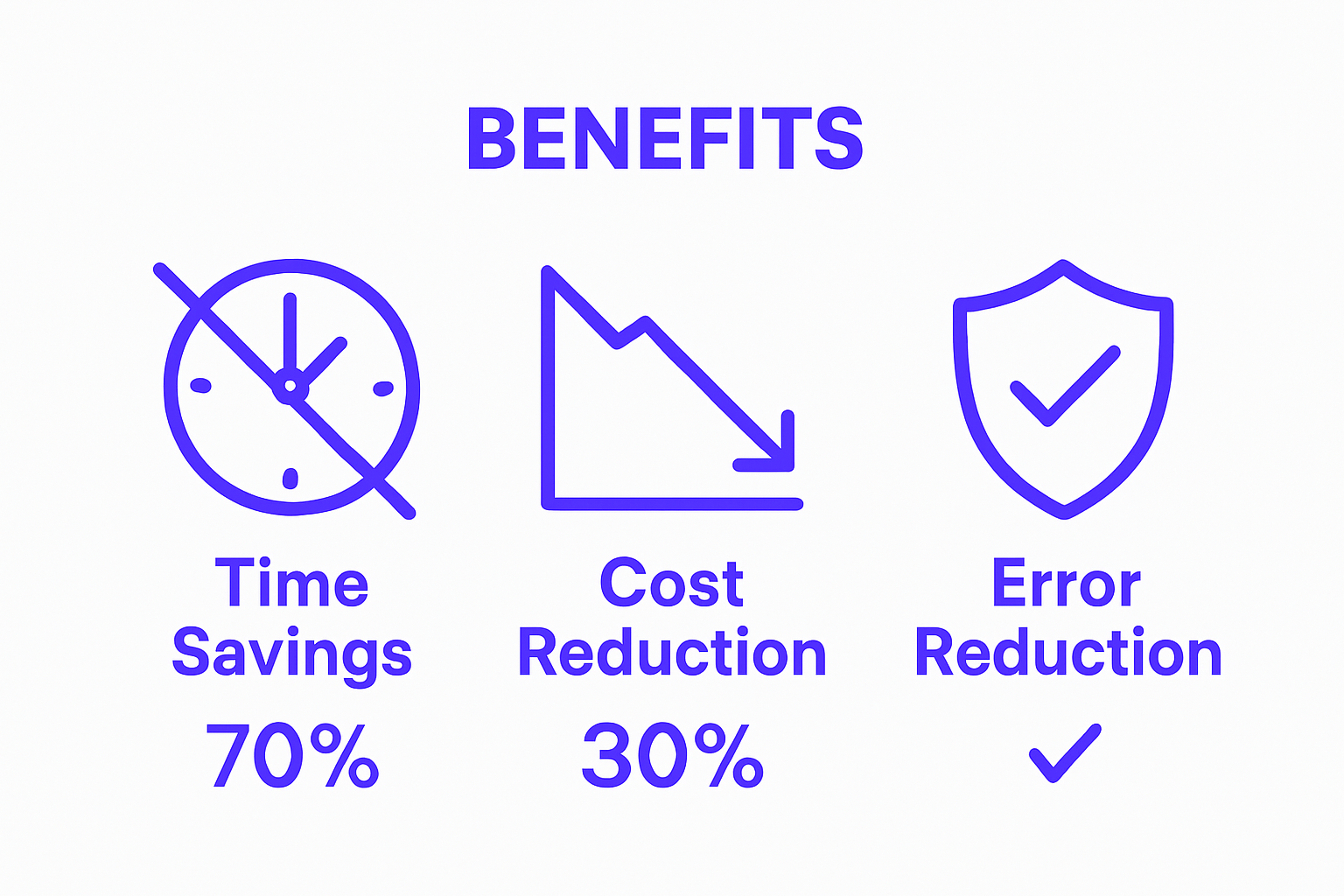
Key productivity improvements include:
- Reducing repetitive administrative tasks
- Accelerating workflow completion times
- Enabling employees to focus on strategic initiatives
- Creating consistent process execution
- Minimizing bottlenecks and delays
Financial and Strategic Advantages
Beyond productivity gains, automation tools offer substantial financial benefits for organizations. Implementing workflow automation can lead to significant cost reductions by streamlining resource allocation and reducing operational overhead.
Financial benefits encompass:
- Lower labor costs
- Decreased operational expenses
- Improved resource allocation
- Enhanced budget predictability
- Reduced risk of expensive human errors

Long-Term Organizational Transformation
Workflow automation represents more than a technological upgrade it is a strategic approach to organizational development. By creating more intelligent, adaptive work processes, businesses can develop greater agility, resilience, and competitive advantage.
The most successful organizations view automation not as a replacement for human workers, but as a powerful tool to augment human capabilities, allowing teams to engage in more creative, strategic, and meaningful work.
How Workflow Automation Works: Underlying Principles
Workflow automation operates through sophisticated technological frameworks that transform complex business processes into streamlined, intelligent sequences. By integrating digital tools and logical decision-making algorithms, these systems create dynamic pathways for task execution and management.
Core Technological Architecture
At the heart of workflow automation lies a complex system of interconnected technologies designed to recognize, interpret, and execute tasks with minimal human intervention. According to Brookings Institution, these systems leverage multiple technological components to create seamless operational environments.
Key architectural components include:
- Trigger Mechanisms: Initial events that activate workflow processes
- Decision Logic Engines: Algorithms that determine task routing and execution
- Integration Protocols: Systems connecting different software and applications
- Data Mapping Frameworks: Processes for translating information between systems
- Reporting and Analytics Modules: Tools for tracking and evaluating workflow performance
Process Mapping and Execution
Workflow automation depends on precise process mapping where each task is meticulously defined, sequenced, and configured with specific rules and conditions. This involves creating digital representations of organizational processes that can be automatically interpreted and executed by technological systems.
The execution process typically follows a structured approach:
- Identifying specific workflow tasks and their interdependencies
- Establishing clear rules and conditions for task progression
- Creating automated decision points and alternative pathways
- Implementing error handling and exception management protocols
- Continuously monitoring and optimizing workflow performance
Intelligent Adaptation and Learning
Modern workflow automation systems go beyond simple task execution by incorporating intelligent adaptation mechanisms. These advanced systems can learn from historical data, recognize patterns, and dynamically adjust processes to improve efficiency and responsiveness.
By combining rule-based logic with machine learning algorithms, workflow automation tools create increasingly sophisticated and self-optimizing operational environments that can anticipate organizational needs and proactively suggest improvements.
Common Automation Tools for Businesses and Their Applications
Workflow automation tools have revolutionized how businesses manage complex processes, offering diverse solutions tailored to different organizational needs. These technological platforms enable companies to streamline operations, reduce manual interventions, and enhance overall productivity.
The following table summarizes popular workflow automation tools mentioned in the article and highlights their primary business function or area of application.
| Tool | Main Function/Area of Application |
|---|---|
| Microsoft Power Automate | Comprehensive workflow automation/integration |
| Zapier | Cloud-based app connection/automation |
| UiPath | Robotic process automation/AI capabilities |
| Nintex | Low-code workflow design/automation |
| Asana | Project management/workflow coordination |
| Greenhouse | HR recruitment workflow |
| Approval Workflow | Finance/expense management |
| HubSpot | Marketing campaign automation |
| Zendesk | Customer service ticket management |
| Salesforce | Sales lead tracking/pipeline management |
Enterprise-Level Workflow Automation Platforms
Enterprise automation tools provide comprehensive solutions for organizations seeking robust, scalable workflow management. According to Stanford University’s IT Community, these platforms offer sophisticated capabilities for integrating multiple business processes.
Key enterprise-level tools include:
- Microsoft Power Automate: Comprehensive workflow automation with extensive application integration
- Zapier: Cloud-based platform connecting multiple software applications
- UiPath: Robotic process automation with advanced AI capabilities
- Nintex: Low-code workflow design and automation platform
- Asana: Project management and workflow coordination tool
Specialized Automation Solutions by Business Function
Different business functions require targeted automation tools that address specific operational challenges. Specialized tools provide targeted solutions for departments like human resources, finance, customer service, and marketing.
Function-specific automation tools:
- HR Tools: Greenhouse for recruitment workflow
- Finance Tools: Approval Workflow for expense management
- Marketing Tools: HubSpot for campaign automation
- Customer Service: Zendesk for ticket routing and management
- Sales: Salesforce for lead tracking and pipeline management
Emerging Trends in Workflow Automation Technology
Workflow automation is rapidly evolving, integrating advanced technologies like artificial intelligence and machine learning. Modern tools are becoming increasingly intelligent, capable of learning from historical data and making predictive recommendations.
Businesses that strategically implement these tools can create more adaptive, responsive operational environments. The future of workflow automation lies in creating seamless, intuitive systems that not only execute tasks but also provide strategic insights and continuous improvement mechanisms.
Real-World Examples of Workflow Automation Success
Workflow automation has transformed how organizations across various industries approach complex operational challenges, demonstrating remarkable improvements in efficiency, accuracy, and strategic performance. By implementing intelligent automation solutions, businesses have achieved breakthrough results that fundamentally reshape their operational capabilities.
Healthcare Process Transformation
Healthcare organizations have been at the forefront of workflow automation adoption, addressing critical challenges in patient care and administrative management. According to The Office of the National Coordinator for Health Information Technology, automation technologies are revolutionizing medical processes.
Significant healthcare workflow automation examples include:
- Patient Intake Automation: Reducing registration times from 20 minutes to 3 minutes
- Medical Record Management: Eliminating manual document processing
- Appointment Scheduling: Creating intelligent booking systems with automatic reminders
- Insurance Claims Processing: Accelerating reimbursement and reducing errors
- Prescription Management: Enabling seamless electronic prescription workflows
Manufacturing and Supply Chain Innovations
Manufacturing sectors have leveraged workflow automation to create more responsive, efficient production environments. Intelligent automation tools have enabled companies to optimize complex logistics and production processes, dramatically reducing operational costs and improving product quality.
Key manufacturing workflow automation achievements include:
- Reducing inventory management processing times
- Implementing real-time quality control monitoring
- Creating predictive maintenance scheduling systems
- Automating supplier communication and procurement processes
- Developing adaptive production line configurations
Financial Services and Banking Transformation
Financial institutions have embraced workflow automation to enhance compliance, reduce risks, and improve customer experiences. By implementing sophisticated automation technologies, banks and financial service providers have streamlined complex regulatory processes and created more personalized customer interactions.
Workflow automation enables financial organizations to transform traditional operational models, creating more agile, responsive, and intelligent systems that can adapt quickly to changing market conditions and regulatory requirements.
Ready to Transform Your Workflow with Simple Solutions?
You read in the article how recurring manual tasks and inefficient processes drain your time, create stress, and keep you from focusing on what really matters. If you feel overwhelmed by never-ending to-do lists or struggle to find practical ways to put workflow automation into action, you are not alone. Business productivity is about making life easier, and streamlined solutions are closer than you might think.
At BreezyTips.com, we specialize in breaking down complex problems into easy-to-follow steps. Whether you want to master workflow automation, fix tech glitches, or boost your daily productivity, our clear guides can help you turn frustration into flow. Discover more practical insights and tips in our latest articles at the BreezyTips Blog. If you are ready to move past bottlenecks and error-prone tasks, visit BreezyTips.com and start streamlining your business and personal routines today.
Frequently Asked Questions
What is workflow automation?
Workflow automation is the use of digital tools to automatically execute, sequence, and manage work tasks with minimal human intervention, aimed at transforming repetitive and complex processes within a business.
Why is workflow automation important for businesses?
Workflow automation is important as it reduces operational costs, improves accuracy, enhances employee productivity, and accelerates process completion times, allowing teams to focus on higher-value activities.
How does workflow automation enhance operational productivity?
Workflow automation enhances operational productivity by eliminating manual processes, reducing administrative tasks, accelerating workflow completion, and minimizing bottlenecks, allowing employees to concentrate on strategic initiatives.
What are some common tools used for workflow automation?
Common tools for workflow automation include Microsoft Power Automate, Zapier, UiPath, Nintex, and Asana, which offer various features to streamline operations across different business functions.